Conrad Hensley
A Man in FullConrad Hensley is a young warehouse worker, husband, and father whose life is repeatedly narrowed by forces beyond his control: a dangerous workplace, job loss, a felony conviction he considers unjust, and the brutal hierarchy of Santa Rita Jail. His defining response is not simple endurance. Through Epictetus, he develops a distinction between external events and the will with which a person meets them; he holds to that distinction in prison, acts when another prisoner is in danger, and carries his beliefs into a fugitive life that eventually brings him to Charlie Croker.
Identity and the Warehouse
Conrad first appears arriving for an evening shift at Croker Global Foods in a Hyundai hatchback. Wearing long johns beneath his flannel shirt and jeans, he keeps the car’s air conditioning roaring as he searches the dusty employees’ lot. A razor-wire fence, a sewage substation, a rendering-works smokestack, freeway construction, and low-flying planes define the industrial landscape around him. The scene places him at the edge of a large commercial operation, but his attention is fixed on the work and the new life he hopes to provide for his young family.
That purpose helps Conrad resist the despair voiced around him on the warehouse floor. While retrieving frozen beef, he catches himself letting the surrounding noise and complaints pull him toward a sense of defeat. He reminds himself that his work is for his family, climbs back onto his pallet jack, and returns to the freezer for another eleven eighty-pound blocks of beef shanks. His resolve is practical rather than triumphant: the shift has only begun, and he chooses to continue it.
The warehouse also becomes the site of an emergency that reveals what Conrad does when someone else is in immediate danger. During a rack collapse, Herbie is thrown from his jack, and Kenny remains frozen while a runaway jack bears down on him. Conrad dives headfirst at Kenny and knocks him clear; the men slide together through spilled pinto beans and a blood-red mess as cartons and racks tumble around them. Once the crash stops, Kenny tells Conrad that he has saved his life. The rescue is an instinctive act, not a calculation, and it establishes a pattern of attention to vulnerable people that will matter again in prison.
The company soon tells Conrad that his services are no longer needed because of a reduction in the facility’s capacity. He can barely speak after reading the notice and confirms it to Kenny and Light Bulb with a nod. The loss of his job compounds the insecurity already present in his working life: the job was part of his plan for his family, yet the decision is made by an institution that offers him no control over its consequences.
Arrest and the Cost of Refusing a Plea
Conrad’s encounter with the towing operation turns an ordinary attempt to retrieve his Hyundai into a confrontation with a physically imposing man in a cowboy hat. Conrad finds the tow truck attaching its chain to a car in the red zone, close to a fire hydrant. His family calls for him to bring their car back immediately, but the dispute escalates. Conrad eventually makes a dash for the Hyundai, gets behind the wheel, and starts it with shaking hands. The episode ends in his humiliation and arrest: he lies face down in the dirt in Oakland, his head burning and his eyes stinging, with dust choking his nostrils.
In that moment of physical defeat, two faces come to him: Arda Otey and his young son, Carl. Carl looks at his father as Conrad once looked at his own father. The image brings the consequences of his choices into a family frame. His crisis is not only a fight over a car or a contest with a stronger man; it touches the example he believes he is setting for his child.
At Santa Rita Jail, the consequences become enduring. A visit with Jill takes place across concrete and Lexan, with the two speaking by telephone despite being only inches apart. Conrad waits anxiously for her to enter, as if missing any part of the visit would make it impossible to endure another week inside. Their separation is both physical and emotional, and the prison’s architecture makes contact seem like a glimpse of life from beyond a sealed boundary.
Jill challenges the value of Conrad’s refusal to accept a plea bargain. He answers that he believed, and still believes, he was innocent, but acknowledges that the jury convicted him and that he lost a great deal. What he says he kept was his honor: he did not bargain away his soul by falsely confessing to a lesser offense. His decision has a severe cost, including imprisonment and strain on his marriage, but he regards a false plea as a compromise of the self that the sentence cannot undo.
The Stoics and Prison Life
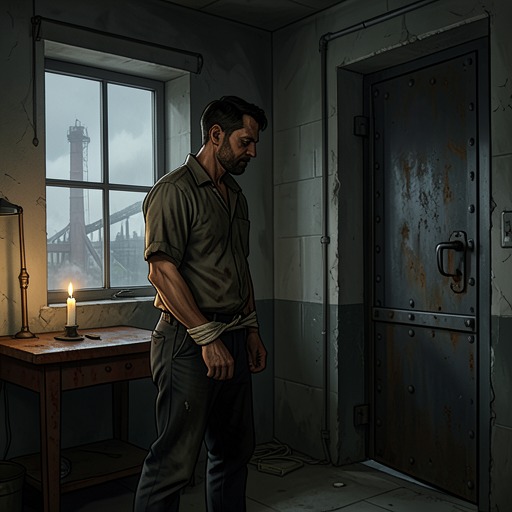
Conrad’s conviction leaves him in a jail organized by threat, rank, and coercion. He watches Rotto and his retinue in the pod room, listens to Five-O and the other prisoners, and tries to write to Jill, Carl, and Christy. The routines are dreary and anxious, but he keeps the bedraggled pages of The Stoics with him. The book gives him a language for separating what he can govern from what he cannot: money, possessions, fame, and power lie outside the will, while the judgments and choices through which a person answers events remain his own.
This is more than abstract consolation for Conrad. He understands his refusal of the plea in terms of character: he would not lower himself by admitting to a crime he did not commit just to reduce the risk of a jail sentence. Epictetus’s image of the purple thread, whose brilliance gives distinction to the rest of a tunic, helps him understand why he could not treat his integrity as an expendable detail. His belief does not erase the conviction or the suffering that follows it; it lets him regard those external losses as different from surrendering his will.
Prison violence tests that distinction in immediate, bodily ways. Conrad sees Mutt Simms reduced to a filthy, terrified state and recognizes that the older prisoner’s degradation began with a rape in a county jail when he was seventeen. Conrad understands the danger awaiting prisoners when they are turned out into the pod room, where it is every man for himself. Later, when Pocahontas collapses and the other prisoners avert their eyes, Conrad is the one who gets up. The episode places his studied Stoicism beside a spontaneous act of compassion: he does not let the pod’s code of false manliness decide whether a suffering person merits help.
In another moment of inward practice, Conrad sits at a bolted metal table, places the pages of The Stoics before him, and shuts out the pod’s noise. He closes his eyes and imagines emptying himself of sensation, becoming a vessel open to the divine. The scene shows how he uses the book: not simply to explain his circumstances, but to train his attention and judgment inside an environment designed to seize both. His faith in the divine spark becomes a conviction that neither the jail nor even Zeus can take away the human capacity to reason and choose.
Escape and the Assumed Name
An earthquake destroys part of the prison and creates the opening through which Conrad escapes. He interprets the sequence through the providential framework he has formed around Epictetus: the book reached him in Santa Rita, and the earthquake then cracked the jail open, making escape possible. As he runs beside the escarpment away from the remains of West Greystone, he gives Five-O a final smile and wave. The escape is at once a physical break from confinement and a test of his effort to accept events without surrendering his capacity to act.
Conrad travels from California to Atlanta under the assumed name Connie DeCasi. His flight is not depicted as a clean return to safety. He has little money, and in Chamblee he is tired from sleeping on the floor at Meadow Lark Terrace, where he curls around his overnight bag and wakes repeatedly amid the noise of a crowded apartment. At Asian Square, he exchanges ten dollars from his remaining cash for rolls of quarters and uses them to call California. In the call, he passes along thanks to the woman in Oakland whose people helped him and to the person who introduced him to her. The exchange confirms that his escape depends on assistance and trust as well as his own resourcefulness.
The fugitive eventually works for Carter Home Care as an attendant to sick people. One of his employers is Charlie Croker. When Conrad comes across Charlie again, the encounter joins the two strands of the novel: the powerful Atlanta businessman facing public and financial collapse, and the convicted California laborer who has crossed the country after a prison escape. Conrad is also the young man who helped Charlie up to the landing for the press conference, a small act of assistance that places him close to the public reckoning of Charlie’s story.
Return of the Book and Narrative Significance
Conrad’s encounter with Charlie is also tied to the return of The Stoics. He notices a dark-blue, dust-jacketless copy, its faded lettering visible on the spine, jammed horizontally on a bookcase shelf. For Conrad, the book is not an ordinary object: he understands it as alive with the spark of Zeus and as the source of the principles that enabled him to withstand prison, estrangement from his family, conflict with the law, and danger after his escape. He asks Charlie whether he has the book with him and asks him to look after it. The request makes the book a link between their separate ordeals, and Conrad’s account of its journey gives Charlie a possible way to understand the prisoner’s convictions.
At the City Hall press conference, Conrad watches Charlie approach the message he has come to deliver. He is exhilarated, but alert to the danger that officials may try to move Charlie away from the podium; Conrad bends his knees and centers his weight, ready to intervene even if that means facing the police. The posture recalls the warehouse rescue: once again, he prepares to act when another person appears vulnerable, though the setting has shifted from a collapsing freezer rack to a charged political event.
Conrad’s identity as a fugitive is finally exposed through a newspaper clipping from Oakland. Wes Jordan explains that California authorities had asked Atlanta police to look for a young man who escaped during the earthquake, and that federal investigators had conducted phone taps. By the time local police found a lead, Conrad had already left Atlanta. The report identifies him as a white young man who had been jailed for aggravated assault and says that he was about to turn himself in and be sentenced in July. It also reveals that Charlie had employed him through Carter Home Care and recalls him as the young man who helped at the press conference. The disclosure recasts Conrad’s quiet presence beside Charlie: he has been living under an assumed name, but has not abandoned the principles that shaped his response to prison.
Conrad’s arc brings Stoic discipline into contact with material vulnerability. His conviction, poverty, family separation, and fugitive status are not solved by philosophy; the book instead gives him a standard by which to distinguish hardship from moral capitulation. His repeated acts of rescue and aid—from the warehouse floor to the prison pod and finally the press-conference landing—make that distinction visible in action. He is both a man acted upon by institutions and circumstances and a man who continues to choose how he will respond.